

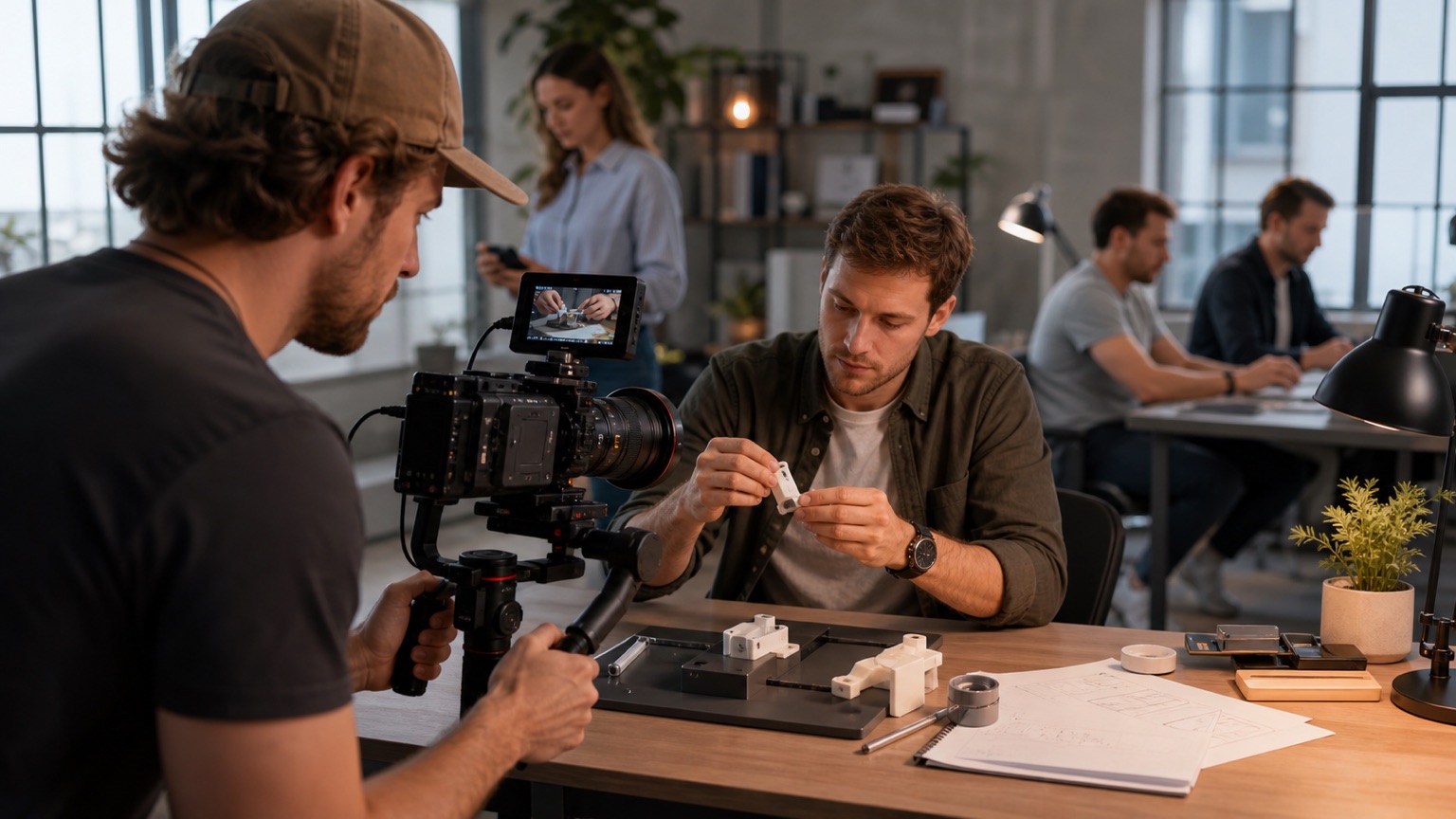
B-roll in a corporate film consists of supplementary shots showing the product, people, space and process while the hero or narrator’s voice is heard in the background. Good B-roll is not decoration. It should prove what the film says, conceal natural shortcuts in statements and guide the viewer through the story. That is why it is worth preparing the list of cutaways based on the script, not adding it at the end of the shooting day.
B-roll in a corporate film starts with the main thesis
First, determine what the viewer should understand after watching the film. It may be about production precision, speed of service, team experience, product simplicity or real change after implementing the service. Each of these theses requires different images. A shot of a person typing on a laptop does not automatically show an efficient process, just as a wide shot of an office does not confirm product quality.
Go through the script sentence by sentence and mark places that can be shown instead of just talked about. If the hero mentions quality control, plan a specific moment of product inspection. If they talk about a short decision path, show information being passed between two people or a task status changing in the tool used. The image should relate to the content, even if it does not illustrate it literally.
Divide the shot list into four functions
A list based solely on rooms usually ends with many similar shots. In editing, a division by function is more useful. It makes it easier to assess whether the material shows the full story or just a nice interior.
1. Introductory shots
They show where we are and the character of the company. This could be the facade, entrance to the studio, a wide shot of the hall, a team starting a meeting or the product in its intended environment. Two or three strong variations are enough. There is no need to film every wall and corridor.
2. Process shots
This is the most important part of B-roll because it turns declarations into specifics. Show successive stages of work, decisions, tools and control points. In a service company, this may be brief analysis, consultation, solution preparation and presentation of the result. In physical production, these will be materials, processing, control and packaging. Each stage is worth recording in wide, medium and close-up shots.
3. Evidence shots
If the film contains an important promise, look for an image that makes it credible. These may be details of workmanship, measurement results, the finished product in use, a document fragment, client reaction or a before-and-after comparison. Confidentiality must be ensured. Data on screens, documents and people’s images should be approved in advance.
4. Transitional and atmospheric shots
They help change location, topic or pace of the film. Effective examples include movement through a door, detail of a machine starting up, change of light in a room, team moving between workstations or a short shot of the surroundings. Such shots are necessary but should not replace images supporting the main message.
How to record the variations needed for editing
One event recorded in a single shot offers few possibilities. Instead of repeating many random actions, choose a few important situations and capture them more thoroughly. First show the whole scene, then the interaction between person and tool, and finally a detail of the hand, product or screen. Change the shot size and angle clearly enough so that the shots can be joined without a visual jump.
- A wide shot establishes the location and relationships between people.
- A medium shot shows the activity and its context.
- A close-up directs attention to detail, quality or decision.
- A static shot provides breathing space and clarity.
- Controlled camera movement emphasises energy or leads to an important element.
Each shot should last several seconds before the action starts and after it ends. This gives the operator a clean entry and exit, and the editor does not have to cut the movement at a random moment. If the action is short, it is worth repeating it in full. This especially applies to opening a product, handing over an object, starting a device and gestures on a screen.
Prepare people and place for real work
The most credible cutaways are created when employees perform familiar tasks. Do not make the team pretend to talk with the monitor off or point at charts without purpose. It is better to prepare a real but safe example of a task. People in front of the camera then know what to do, and the operator can focus on composition and variations.
Before shooting, remove client data, private notifications, IDs and outdated brand materials from the frame. Also check consents for image use and the possibility of showing the location. Tidiness does not mean sterility. Tools, notes and traces of a real process often build credibility, provided they do not distract from the scene’s hero.
How much B-roll to plan for a shooting day
There is no single number of shots suitable for every film. The scope depends on the length of the material, number of locations, editing pace and how long the hero speaks to the camera. Instead of setting a random limit, assign at least one image to each important part of the statement, and prepare two or three variations for key theses.
Divide the list into mandatory and additional shots. First record the process, product and evidence supporting the main message. Only then collect interior details and impressive camera movements. It is worth allocating a separate time block for B-roll before conversations and organisational delays take up the entire schedule.
Most common mistakes with cutaways
- Recording only general shots of the office unrelated to the script.
- Repeating keyboard, phone and meeting shots as images for every service.
- Lack of close-ups of the product, hands and quality control points.
- Shots so short that they cannot be used freely.
- Different light temperatures, image settings or random movement styles.
- Showing data, screens and people without prior consent.
Filming everything in slow motion is also problematic. Slow motion can emphasise detail but does not replace clear process demonstration. If every action is slowed down, the company starts to look less efficient, and editing loses contrast between calm and dynamic moments.
Short B-roll checklist for the client
- Write down the three most important theses of the film.
- Add an image to each thesis that illustrates or confirms it.
- Choose real processes, people, products and locations.
- Mark mandatory and additional shots.
- For key activities, plan wide, medium and close-up shots.
- Check consents, data confidentiality and site readiness.
- Reserve dedicated time for B-roll in the shooting schedule.
Planning a corporate film and want to return from the shoot with material that can really be well edited? SVISUALS can prepare a shot list, conduct the recording and assemble everything into versions ready for the website, YouTube and social media.
Get a quote for a corporate film →